FX & Payments
Market orders: target a better exchange rate and protect your budget
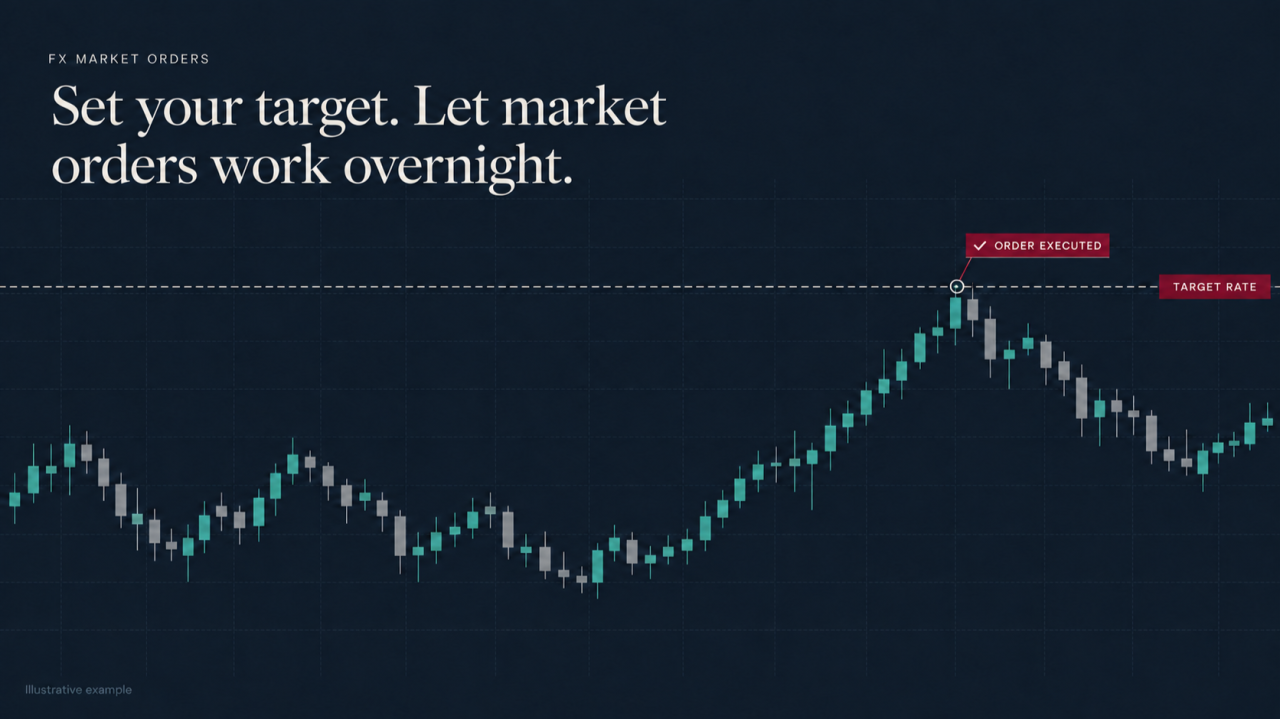
A market order lets your business set an exchange-rate instruction in advance, so your provider can act without waiting for you to approve the transaction.
For business currency payments, two common types are limit orders, which target a more favourable rate, and stop-loss orders, which trigger a conversion if the rate moves against you to a specified level.
They can help you capture opportunities outside UK office hours and manage the risk of a payment becoming more expensive.
You decide the instruction beforehand. Your provider acts under the agreed terms when the conditions are met.
Put your target rate to work
Suppose your business needs to pay a €100,000 supplier invoice. At an illustrative exchange rate of €1.17 to the pound, the sterling cost would be approximately £85,470, excluding fees.
You have some flexibility before payment is due and would prefer to buy at €1.19. At that rate, the same invoice would cost approximately £84,034: a saving of £1,436.
A limit order allows you to instruct your provider to automatically execute at your target rate if it becomes available.
That means you do not need to spot the movement, stop what you are doing and call before the opportunity disappears.
Watching an exchange-rate chart more intently does not, regrettably, improve the rate.
Your target should still reflect your budget and payment deadline. If it is never reached, the order may remain unfilled and your invoice will still need paying.
An opportunity does not always arrive during office hours
Some of our clients placed market orders ahead of a UK interest rate decision, setting their preferred exchange rates in advance.
These orders subsequently filled outside UK office hours. The rates then moved away from those levels, meaning the opportunities would have been missed had the clients waited until the next working day.
The value was in having instructions ready when the rates became available. These clients did not need to predict the precise movements or be available to answer a call.
A rate alert tells you the market has moved. An order authorises your provider to act.
Out-of-hours execution depends on the provider, currency and agreed order coverage. Your target must also be available at an executable customer rate; seeing a number briefly appear on a public chart does not necessarily mean your order can fill.
Give your budget a boundary
A stop-loss order helps address the opposite concern: what happens if the rate gets worse?
For the same €100,000 invoice, suppose your business has budgeted at €1.15 to the pound. That allows approximately £86,957 for the payment.
If sterling falls to €1.13, the cost rises to approximately £88,496. That is another £1,539 to find, without receiving a single additional item from your supplier.
A stop-loss instructs your provider to trigger a conversion when an agreed adverse rate level is reached, helping limit exposure to further deterioration.
However, a standard stop-loss does not guarantee an exact minimum rate. If prices move sharply or jump past the trigger, execution may occur at a worse rate.
If your budget cannot tolerate anything below a particular level, discuss that before placing the order. A trigger above your budget rate may provide some headroom, but certainty may require fixing an acceptable rate in advance through a suitable forward contract, subject to its terms and funding requirements.
Agree the plan before the pressure arrives
Before placing an order, establish the currency amount, target rate, protective trigger where appropriate, and expiry date. Confirm how you will fund the transaction if it executes and allow time for the supplier payment to arrive.
Where available, a limit order and stop-loss can be linked so that execution of one automatically cancels the other. This lets you pursue a better rate while setting a point for action if the market moves against you.
An order is a dealing instruction, not simply a request for a helpful phone call. Once executed, the resulting trade is binding under the agreed terms.
The aim is to make a considered decision while you have time to think, rather than an increasingly creative justification for waiting.
If you have a target exchange rate or a budget you need to protect, speak to the Reciprocal team about the market orders available for your next international payment.
Cookie Preferences
We use cookies to enhance your experience. Read our Cookie Policy and Privacy Policy.